
Do You Need a VPN on Your iPhone?
Your iPhone already has strong security and privacy features, so no, you do not automatically need a VPN every time you use it.
A VPN becomes useful when you want another layer of network privacy: protecting your connection on networks you do not control, hiding your real IP address from websites, or extending privacy beyond Safari to internet traffic routed through the VPN.
The important distinction is this:
An iPhone can be secure without your internet connection being as private as you want it to be.
That is where a VPN can help.
When Do You Actually Need a VPN on iPhone?
There is no good reason to tell every iPhone owner that they are unsafe without a VPN.
A better question is: what are you trying to protect?
| Situation | Is a VPN useful? | Why? |
| Airport, hotel, or cafe Wi-Fi | Yes | Adds an encrypted tunnel on a network you do not control |
| Home Wi-Fi you trust | Optional | Your connection may already be reasonably protected, but a VPN adds IP and network privacy |
| Mobile data / 5G | Optional | Useful if you want to reduce what your carrier can observe and replace your visible IP |
| Traveling | Useful | Protects unfamiliar connections and lets you choose a VPN location |
| Hiding your real IP from websites | Yes | Websites see the VPN IP instead |
| Using iCloud Private Relay | Depends | Private Relay protects important traffic, but it is not the same as a device-wide VPN |
| Banking on your normal home connection | Usually optional | Banking apps and websites already use encrypted connections; a VPN is not a substitute for account security |
| Trying to become completely anonymous | No | A VPN alone cannot make you anonymous |
If several of the Yes or Useful situations sound familiar, an iPhone VPN probably makes sense for you.
You can also see how KlarVPN works on our [VPN for iPhone](/vpn-for-iphone) page.
Your iPhone Security and Your Network Privacy Are Different Things
Apple puts a lot of security into the iPhone.
iOS includes app sandboxing, strong device encryption, permission controls, Safari privacy protections, private Wi-Fi addresses, phishing warnings, and other built-in security features.
For Wi-Fi privacy specifically, the iPhone can use a different private MAC address for each network, making it harder for different Wi-Fi operators to track the same device across networks. Safari also includes Intelligent Tracking Prevention and IP-hiding options for known trackers. Apple Support
Those features are valuable.
But they solve different problems from a VPN.
When you use a VPN, your iPhone creates an encrypted connection to the VPN service. Traffic routed through that connection travels through the VPN tunnel before continuing to its destination.
That means a VPN can give you two important things Apple device security alone does not automatically provide across your normal internet connection:
- Another layer between your iPhone and the network you are using.
- A different public IP address for websites and online services to see.
Think of it this way:
Your iPhone protects the device.
HTTPS protects individual connections to websites and services.
A VPN protects the path between your device and the VPN service.
They complement each other rather than replacing one another.
Do You Need a VPN on Public Wi-Fi?
This is one of the best reasons to use a VPN.
Your home network is yours. Wi-Fi at an airport, hotel, cafe, conference centre, or coworking space isn’t.
That does not mean every public Wi-Fi network is dangerous. Modern websites and apps usually use HTTPS, so the old idea that anyone sitting in a coffee shop can simply read every password travelling across the network is outdated.
But you still do not control the network.
A VPN adds an encrypted tunnel before your traffic crosses that local connection, giving you more privacy from the network operator and other parties observing the local network.
It is particularly useful if you regularly work or browse from:
- Airports
- Hotels
- Cafes
- Universities
- Coworking spaces
- Convention centers
- Guest Wi-Fi
- Other unfamiliar networks
A VPN cannot make a fake login page safe or stop you from entering a password into a phishing site. But it can reduce how much trust you need to place in the network itself.
For a deeper explanation, read Should You Use a VPN on Public Wi-Fi?
Do You Need a VPN When Using Mobile Data?
Not necessarily.
Cellular networks are different from open public Wi-Fi, and using 5G or LTE does not suddenly make your connection unsafe.
But a VPN can still be useful on mobile data.
Your mobile carrier provides the underlying internet connection. A VPN encrypts traffic between your iPhone and the VPN server and replaces the public IP websites would normally see with the VPN server’s IP.
So you may want a VPN on mobile data if your goal is:
- Reducing network-level visibility
- Hiding your normal carrier IP from websites
- Keeping the same privacy setup as you move between Wi-Fi and cellular
- Using a VPN location while travelling
A VPN does not give you free mobile data or bypass your carrier’s data allowance. VPN traffic still travels over your mobile connection and can actually add a small amount of overhead.
For many people, using a VPN on cellular data is therefore a privacy choice, not a necessity.
Doesn’t Apple Already Have iCloud Private Relay?
Yes, and this is where the answer becomes more nuanced.
If you subscribe to iCloud+, Apple includes iCloud Private Relay.
Private Relay is designed to stop any single party from seeing both who you are and which websites you browse. Apple says it protects Safari web browsing, DNS requests, and insecure HTTP traffic, while hiding your IP behind temporary addresses. Apple Developer
That is significant protection.
But Private Relay and a VPN are not identical.
iCloud Private Relay
Private Relay is tightly integrated with Apple and is mainly designed around Safari and supported web traffic.
It also deliberately preserves an approximate geographic area so websites can continue providing locally relevant content. Apple Support
A VPN
A VPN creates a separate network tunnel and can protect internet traffic routed through that VPN connection from apps across the device, not just Safari browsing.
It also lets you deliberately select a VPN location.
So if most of your concern is Safari privacy, and you already pay for iCloud+, Private Relay may cover much of what you want.
If you want device-wide VPN protection, selectable VPN locations, or more control over the VPN connection itself, a VPN offers something different.
We cover the difference in detail in [iCloud Private Relay vs VPN](/blog/icloud-private-relay-vs-vpn).
When Is a VPN Optional on an iPhone?
A VPN is useful, but more software is not automatically better.
You may decide you do not need one constantly if:
- You are on your trusted home network.
- You mainly use Safari with iCloud Private Relay enabled.
- You are not concerned about your visible IP address.
- A service works poorly while the VPN is connected.
- You need your normal local IP for a specific app or network.
- Maximum connection speed matters more than the additional privacy layer at that moment.
Some websites, workplaces, schools, banking services, and other systems may treat VPN or relay traffic differently because they use IP addresses for security, filtering, fraud detection, or access controls. Apple documents similar compatibility issues with Private Relay. Apple Support
Turning a VPN off temporarily does not mean you have somehow made your iPhone insecure.
It simply means you are choosing not to use that additional network-privacy layer for that connection.
Should You Leave a VPN On All Day?
You can, but you do not have to.
Keeping your VPN connected all day is convenient if your iPhone constantly moves between networks.
For example:
Home Wi-Fi → mobile data → office Wi-Fi → cafe → mobile data → hotel Wi-Fi
Instead of deciding whether you trust each network, the VPN remains part of the connection throughout the day.
That is particularly useful when your VPN has Auto-Connect and a Kill Switch.
Auto-Connect reduces the chance that you forget to enable protection when joining a new network. A Kill Switch helps prevent traffic from continuing outside the VPN if the protected connection unexpectedly drops.
There can still be reasons to disconnect: a local service may not work properly, a banking app may dislike the VPN IP, or you may want the lowest possible latency.
So the practical answer is:
Leave your VPN on when consistent network privacy matters. Turn it off when you have a specific reason to use your normal connection.
What Does a VPN Actually Protect on Your iPhone?
A VPN mainly changes what happens at the network layer.
When connected, it can:
- Encrypt traffic between your iPhone and the VPN service
- Hide your normal network IP from websites
- Reduce visibility for the local network you are using
- Protect traffic routed through the VPN across supported apps
- Let you use another VPN location
But there are limits.
A VPN does not automatically hide:
- Your identity after you log into Google, Instagram, Facebook, Amazon, or another account
- Cookies stored in your browser
- Every form of browser or device fingerprinting
- Information you give directly to an app or website
- Your GPS location if you grant an app location permission
- Malware already installed on your device
- Passwords you enter into phishing websites
And it cannot make you completely anonymous.
That is why good VPN advice should start with understanding what a VPN actually hides, not with promising invisibility.
See our complete guide to what a VPN hides.
What Should You Look for in an iPhone VPN?
If you decide that a VPN makes sense for you, the provider matters more than the fact that you have a VPN icon in the status bar.
Remember what a VPN does: it becomes part of the path your internet traffic takes.
You are changing who you need to trust.
Look for a service that clearly explains:
What it stores
“No logs” is not enough by itself. Find out exactly what the provider records for account management, billing, bandwidth, diagnostics, and active connections.
How the connection is protected
Look for modern VPN protocols, strong encryption, and practical safeguards such as a Kill Switch.
What happens when networks change
Phones move between Wi-Fi and mobile data constantly. Reliable reconnection and Auto-Connect matter more on an iPhone than many flashy feature lists.
How the free plan makes money
A free VPN still has infrastructure costs.
Check whether the free tier uses ads, tracking, reduced privacy features, or simply limits usage.
Whether you can verify the privacy claims
This is one area where KlarVPN takes a different approach.
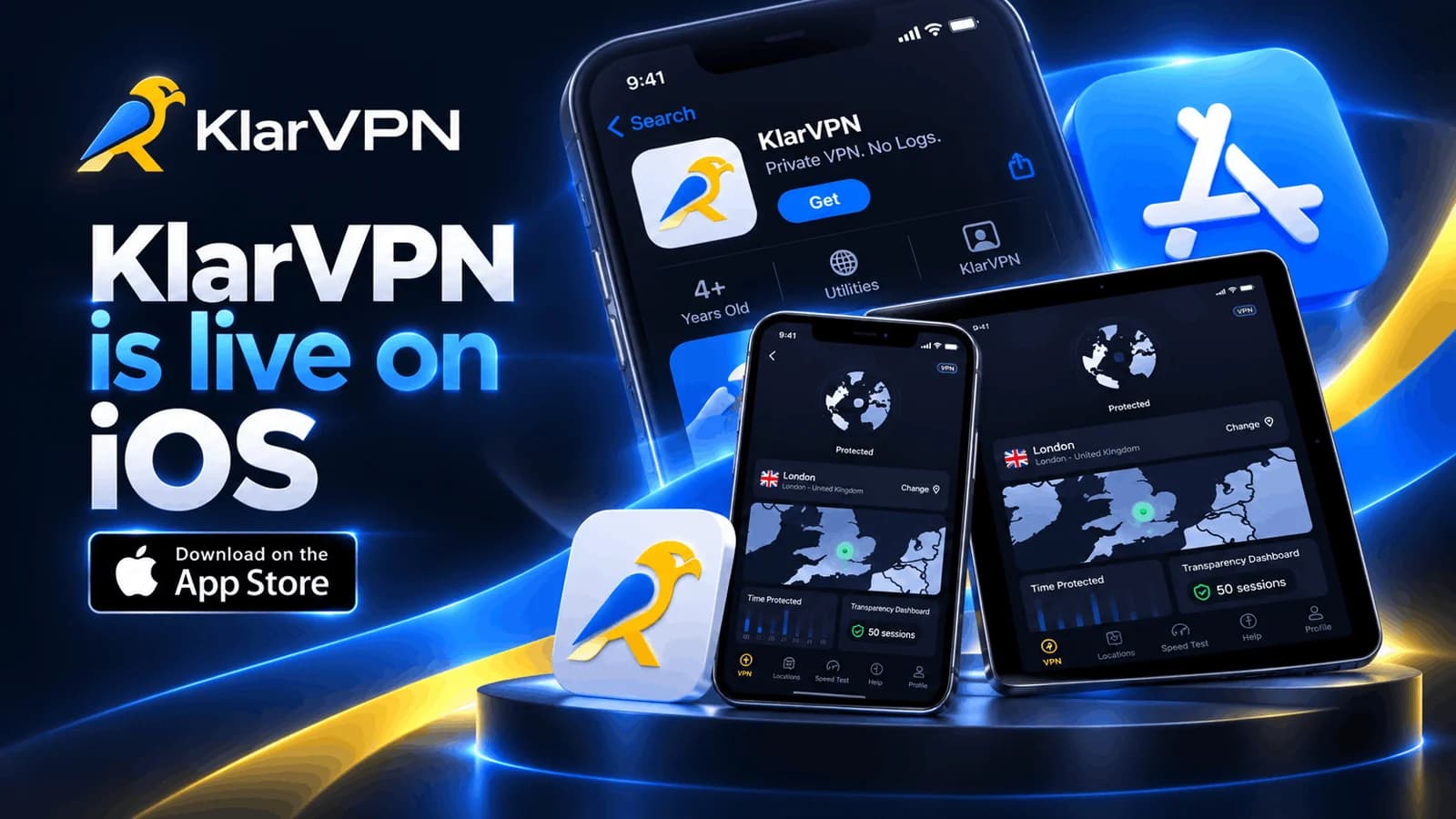
KlarVPN gives each account an isolated encrypted tunnel with its own session keys, while its Transparency Dashboard shows the data associated with your account. KlarVPN’s current privacy policy says it meters total bandwidth for plan limits and temporarily holds an account identifier and connection timestamp while the VPN session is active; it does not store browsing history, DNS queries, destination IPs, or VPN traffic contents.
The free iPhone plan currently includes 3 GB each month, with Kill Switch and Auto-Connect available as part of the app.
So, Do You Need a VPN on Your iPhone?
For most people, the best answer is:
You do not need a VPN just because you own an iPhone. You need one when its network-privacy benefits solve a problem you actually have.
Use one if you regularly connect to networks you do not control, want to hide your normal IP address, want VPN protection beyond Safari, travel frequently, or simply prefer another privacy layer between your iPhone and the internet.
It is more optional if you mainly use trusted networks, already rely on Apple’s privacy features, and do not need the additional IP or network privacy.
And remember: a VPN complements iPhone security.
It does not replace it.
If those extra protections make sense for the way you use your phone, you can download KlarVPN for iPhone and start with 3 GB free each month.
Frequently Asked Questions
Do iPhones need a VPN on public Wi-Fi?
A VPN is useful on public Wi-Fi because it adds an encrypted tunnel between your iPhone and the VPN service on a network you do not control. Modern HTTPS already protects much of your web traffic, so public Wi-Fi is not automatically unsafe, but a VPN adds another layer of network privacy.
Do I need a VPN when using mobile data?
Usually not for basic security, but you may still want one for privacy. A VPN hides your normal carrier IP from websites and encrypts traffic between your iPhone and the VPN provider. It can also keep your privacy setup consistent when your phone switches between Wi-Fi and cellular data.
Does Apple already protect my iPhone traffic?
Apple includes several protections, including private Wi-Fi addresses, Safari tracking protection, HTTPS support, and iCloud Private Relay for eligible iCloud+ subscribers. Private Relay provides meaningful web privacy, but it is not identical to a full VPN and does not replace one in every use case. Apple Support
Should I leave a VPN on all day?
You can if you want consistent network privacy, particularly if you frequently move between Wi-Fi and mobile data. But it is reasonable to disconnect when a trusted service requires your normal connection, the VPN causes compatibility problems, or you want the lowest possible latency.
Can a VPN make my iPhone anonymous?
No. A VPN hides your normal IP and protects your network connection, but websites and apps may still identify you through logins, cookies, device information, browser fingerprinting, GPS permissions, and information you provide directly.